

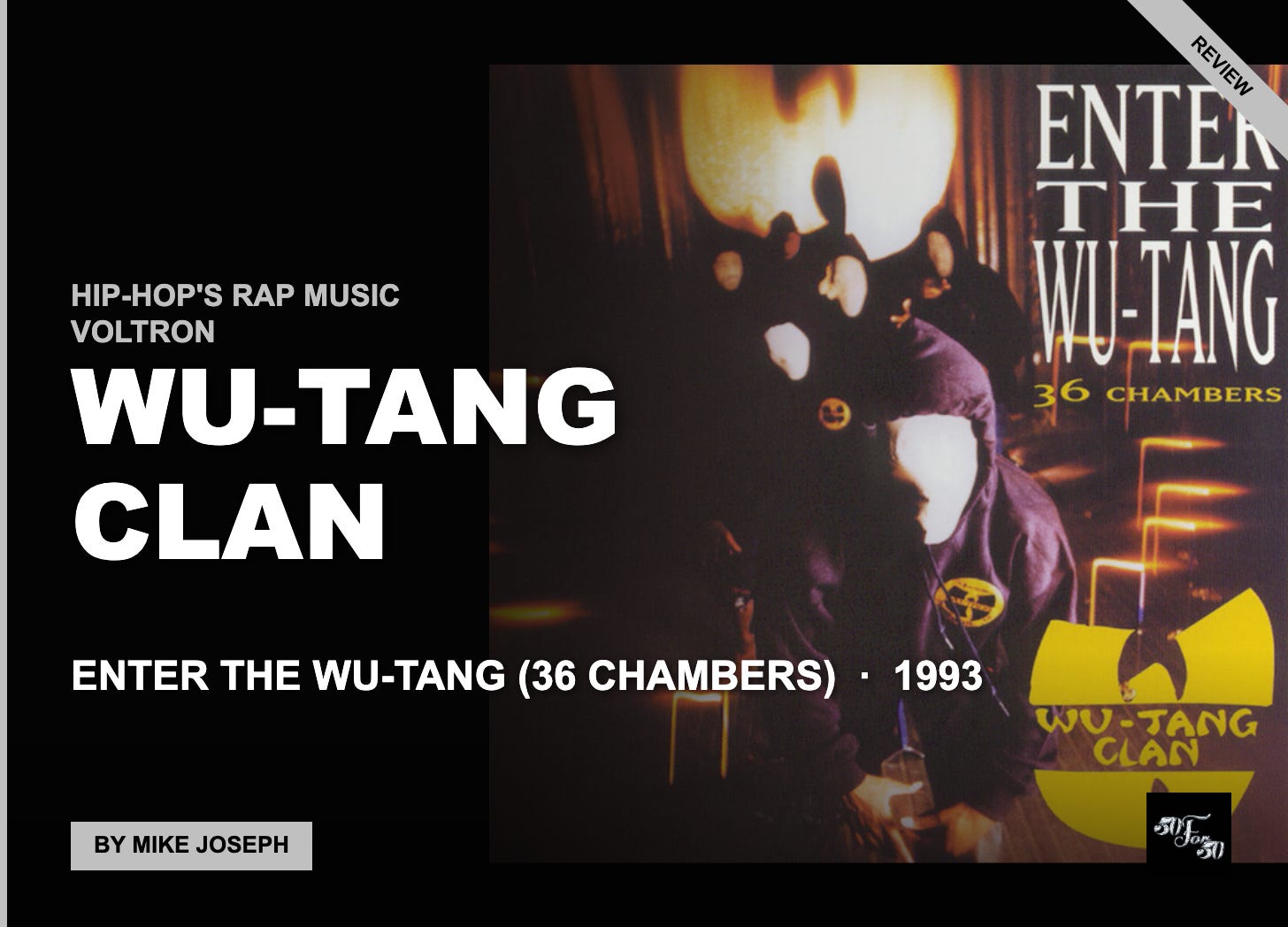
In 1993, nine emcees emerged from Staten Island, NYC’s oft-forgotten fifth borough, and staked their claim to hip-hop immortality. Wu-Tang Clan embodied nothing that had been seen in hip-hop before or since; a rap music Voltron dripping with street knowledge, charisma, lyrical dexterity, storytelling skills and production that was avant garde while still making heads’ necks snap. Enter The Wu-Tang arrived during an era when New York City still had most of hip-hop’s attention (The Chronic, released late in 1992, had just begun to turn the tide), and arguably was part of NYC’s last stand as rap’s epicenter (along with albums like Tribe’s Midnight Marauders and Nas’ Illmatic).
How can I even begin to describe the Wu-Tang ethos accurately? They are the hip-hop equivalent of New Edition. They are the East Coast N.W.A. (at least in terms of how they formed as a group and later split into individually legendary solo acts while occasionally reforming). They are 100% of their era–the references to comics and kung-fu could only come from kids who grew up in 1970s and 1980s New York City, when Saturday afternoons were equally split between cartoons, wrestling and Bruce Lee movies on TV. The dark NYC they (and those of us who lived in the city pre-Guiliani and Bloomberg) inhabit is almost hard to imagine in a post-gentrification Big Apple. Enter the Wu is a time capsule that’s generally only decipherable by those of us who are old enough, and were lucky (or unlucky) enough to share the same geography. Hell, even the (recognizable) samples and interpolations– Gladys Knight’s “The Way We Were,” Hall & Oates’ “Method of Modern Love”- are locked into a certain era of pop culture that makes Enter The Wu a Gen X classic.
Almost every emcee in the unit gets the chance to shine, which is truly shocking when you consider how many rappers are jockeying for air time, and one track is a solo showcase for the incredibly charismatic Method Man. While he’s widely considered the Wu’s MVP, you also gotta give props to Raekwon and Ghostface for their vivid storytelling skills on “C.R.E.A.M.” or the wildly creative and pointed verse GZA drops on “Protect Ya Neck.” Ol’ Dirty sprinkles his chaotic craziness throughout the album, and you can’t not give a hat tip to The RZA for a truly unique production style that intertwined soul classics, film dialogue and the slightly off-beat drum style that propelled what would later become neo-soul. There are clear precedents- RZA’s style is a little bit DJ Premier, a little bit Prince Paul and a little bit Erick Sermon circa Redman’s first album. But he spins it into something entirely his own.
It’s hard not to look at this album through the prism of everything that’s transpired in the three decades since, from RZA’s transition into film scoring to ODB’s untimely passing to Ghostface emerging as the Wu member with the most consistent solo discography. It can be argued that no subsequent Wu-Tang album-individually or collectively-has eclipsed the debut. But how can you top the escapades of so many hungry emcees at a peak time for NYC hip hop? Enter The Wu endures as one of hip-hop’s most highly regarded albums and has been incredibly influential for several subsequent generations of emcees.
