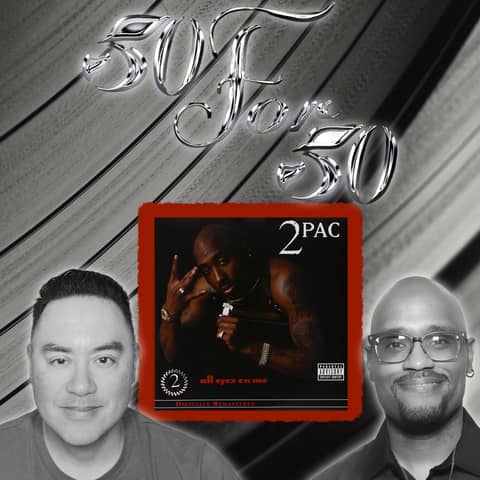
From 19 to 50: Why Tupac’s All Eyez On Me Hits Differently Now
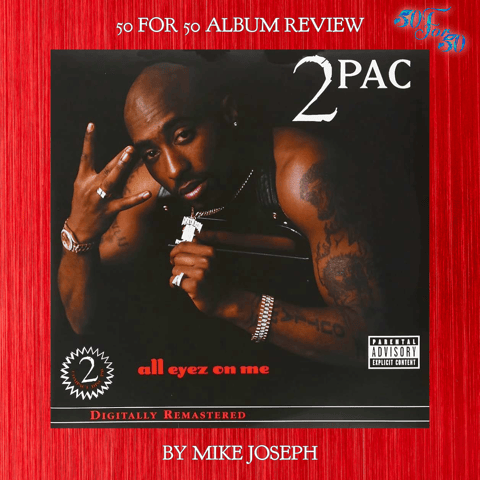
It’s hard to listen to, much less review, Tupac Shakur’s All Eyez On Me without taking in all that happened in the months leading up to the album’s release, and all that happened in the months after the album’s release.
That feels a little silly to write—of course you want to take in context when consuming a piece of art–but it also is a way to highlight a stretch in which the musician and actor known as 2Pac witnessed a commercial breakthrough (thanks to the top 20 pop hits “I Get Around” and “Keep Ya Head Up”), got involved in a shootout with Atlanta-area cops (and beat the charge), was accused of sexual assault (did not beat that charge), was robbed, beaten and shot in the lobby of an NYC recording studio, became the first artist to have a Number One album while incarcerated, delivered an incendiary interview to Vibe Magazine in which he insinuated that his friend The Notorious B.I.G. and some of his associates were aware of the studio assault/shooting before it happened (pouring gallons of gasoline on already-rising tensions between hip-hop factions on the coasts), got bailed out of jail by Death Row Records’ Suge Knight (who was more than happy to assist Pac in said pouring of gasoline), recorded over 150 songs, filmed two movies, and was ultimately shot to death on the Las Vegas strip following a Mike Tyson fight. A timeline like this is absolutely dizzying–it’s hard to believe all of these events occurred between summer 1993 and early fall 1996, with All Eyez On Me’s release coming only eight months before Tupac met his untimely (but self-prophesied) demise.
Thirty years following 2Pac’s death, you may know him as a folk hero, a shit-starter, a cultural icon whose image is preserved in amber. He’s certainly one of the most influential pop culture figures of the latter 20th century, but how much of that is actually due to the music? Opinions may vary, but to my ears, Pac’s music was pretty hit or miss. He was certainly not an emcee of incredible skill. Much like his stylistic predecessor Chuck D, 2Pac’s artistic talent lay more with emotion than it did technical proficiency. That emotion, used to its best effect on 1995’s paranoid and often somber Me Against the World, is more scattered over the course of the two-discs and 90+ minute running time of its follow up, All Eyez On Me, the last album Pac released during his lifetime (unless you believe that he’s still alive, in which case…)
When Eyez was released in January 1996, I was 19 years old. I was newly unemployed, living off of meager savings and unable to participate in my favorite pastime, which was buying records. After a little under two months of no income, I was able to secure a job and the first music purchase I made once I knew I was getting regular paychecks again was All Eyez On Me (The Fugees album was gonna have to wait). I took those tapes home and studied them like I was cramming for an exam. There were some moments of bluster that I thoroughly enjoyed just because they were brash and energetic (“Heartz Of Men” and the “California Love” remix). There were some moments of girl-chasing bravado that I enjoyed because they were playful and not altogether sleazy (“How Do U Want It”, “What’s Ya Phone #”--although maybe I liked the latter song more for the Time sample). There were a couple of moments of introspection that I found endearing (“Life Goes On” and “I Ain’t Mad at ‘Cha”). There were guest appearances that I was checking for; Dre, Meth and Red, Snoop and three of the four members of Jodeci, to name a few).
Also, there were also at least a dozen songs of filler. I’m not totally sure I realized it back in the day, but I sure as hell realize it now: All Eyez On Me is a solid single album that gets pulled down a couple points because of its length. Maybe that doesn’t make much of a difference now that the way we listen to music has changed, but that certainly made a huge difference when we were rewinding and fast-forwarding fragile cassettes (and we had the attention spans to consume entire albums). After a while, you realize that Pac is just recycling themes. The producers (a varied bunch that includes Dr. Dre, DeVante Swing, Quincy Jones’s son QDIII and more) are recycling G-funk musical tropes. Hell, Pac damn near is recycling song titles by the end of the album. Thirteen songs is enough and when you double that, and the law of diminishing returns quickly sets in.
It’s now 2026. I’m creeping up on 50 years old, almost twice the age Pac was when he was murdered. It’s hard for me to listen to All Eyez On Me these days. The sex songs that I thought were kinda funny thirty years ago now come across as moderately to painfully misogynist. The thug/gangsta posturing-with the knowledge that Pac was more or less perpetrating a fraud and employing method acting to the hilt-feels formulaic and forced and antithetical to hip-hop’s “keep it real” ethos. I listen to this album now and I kinda feel like I fell for a con job.
And, look, I’m not saying Pac is the only rapper whose music and image I now have a bit more of an aversion to. As I’ve gotten older, there are a lot of artists and albums that I’ve had to reckon with from a moral standpoint and say “nah, not for me.” I’m also not here to shit on anyone’s hero. I’m just one guy with an opinion just like you and you and everyone else typing words out on a screen. And Pac’s life story clearly lines out the societal and familial circumstances that his music career laid out.
More than anything, re-listening to All Eyez On Me retroactively makes me really sad that Tupac didn’t get the chance to grow and possibly make some of the same realizations that I did.
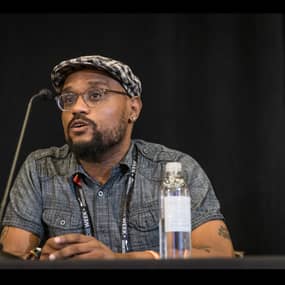
Author and Podcaster
Mike Joseph has been a music obsessive almost his whole life. The New York native was honored by Billboard Magazine in 2020 as a "Pride Power Player", celebrating a career in the music industry that's lasted over three decades. Mike has also worked as a music journalist, a radio announcer, and since 2020 has produced and hosted the podcast "Detoxicity", which shines a light on men's mental health.
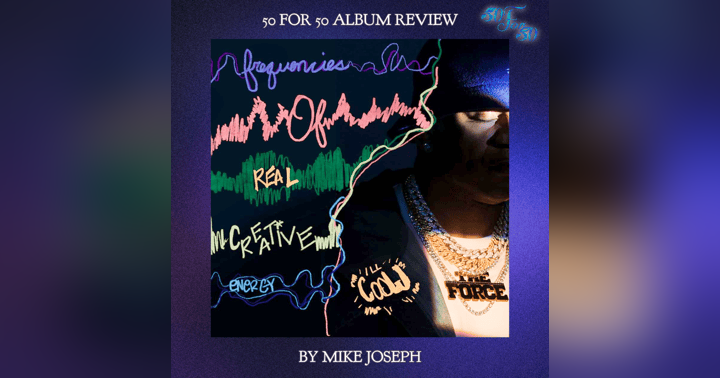
LL Cool J’s ‘The FORCE’ Review: A Definitive Return to Form