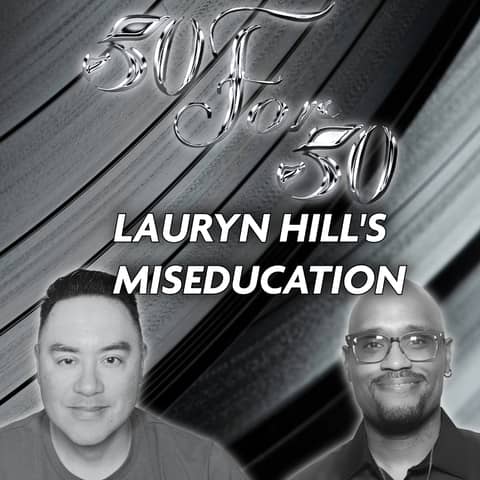
More Than a Fugee: Why Lauryn Hill Was Always the Trio’s True North

Group dynamics are always a tricky thing. Even if a collective is set up with the intention of being a democracy, there will always be some kind of imbalance. Someone’s gonna get more lead vocals, someone’s gonna get more production credits, fans are going to gravitate toward certain members over others. Even when the talent is fairly evenly distributed amongst members, it’s incredibly difficult for one or two members to not shine brighter than others.
Let’s be clear here, though. The distribution of talent in The Fugees was never equal. Not to say Wyclef Jean isn’t incredibly talented (Pras Michel less so). But the reality is that Lauryn Hill possessed a level of talent, charisma and star quality that led to music business observers calling for her to go solo almost the moment the first Fugees album was released. She rapped and sang circles around her bandmates, but whether out of loyalty to the group dynamic or loyalty to Wyclef, who she’d developed a romantic relationship with, Lauryn stuck around through 1994’s Blunted on Reality and 1996’s The Score. The latter album elevated the group into the stratosphere, earning millions of sales and Grammy Awards, in large part due to the Lauryn-led cover of Roberta Flack’s “Killing Me Softly With His Song”.
It’s funny how money change a situation.
Lauryn’s first solo album, The Miseducation of Lauryn Hill, officially kicks off with those words. Sure, there’s the classroom intro that sets the album out, but that intro (and the rest of the interludes) can be programmed out in today’s digital age so that Miseducation can properly kick off with “Lost Ones,” wherein Lauryn lays waste to her former bandmate (without mentioning him by name) in a masterclass of emceeing. “Lost Ones” is why Lauryn is still regularly mentioned in GOAT rapper lists despite a small body of work and despite the fact that’s she’s better known as a singer.
Speaking of which, it’s not uncommon these days for artists to sing and rap interchangeably. Not so much in 1997. Miseducation blurred the lines between hip-hop and R&B more than any album that came before it. Lauryn switched back and forth between disciplines effortlessly from track to track, and sometimes within the same track (like the singles “Doo Wop (That Thing)” and “Everything Is Everything”). Fusion is the name of the game. Even the production does a fantastic job of blending the past and the future. “Every Ghetto, Every City” deftly combines a head-nodding beat with synthesizers that recall peak-era Stevie Wonder, while contemporary R&B heroes like D’Angelo and Mary J. Blige slide in seamlessly alongside rock legend Carlos Santana, whose cameo appearance on “To Zion” kicked off one of the most improbable comebacks in music history.
With the benefit of hindsight, it’s clear that so much of Miseducation is a diary of Lauryn’s professional and personal relationship with her bandmate. She poured her pain into songs that resonated with an audience beyond what even The Score’s massive sales and critical acclaim would predict. The deeply felt lyrics and timeless music struck such a chord that Lauryn is able to coast on the glow of its goodwill more than a quarter-century later.
Author and Podcaster
Mike Joseph has been a music obsessive almost his whole life. The New York native was honored by Billboard Magazine in 2020 as a "Pride Power Player", celebrating a career in the music industry that's lasted over three decades. Mike has also worked as a music journalist, a radio announcer, and since 2020 has produced and hosted the podcast "Detoxicity", which shines a light on men's mental health.
LL Cool J’s ‘The FORCE’ Review: A Definitive Return to Form