John Mayer's Continuum: No Hits, No Problem | 50 for 50
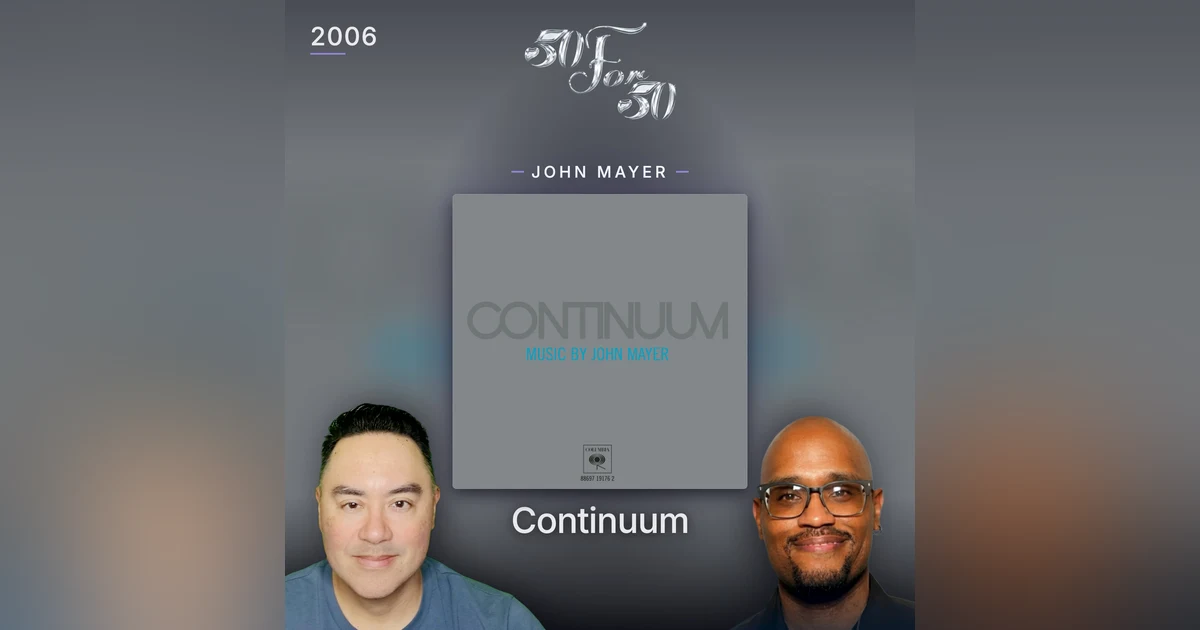
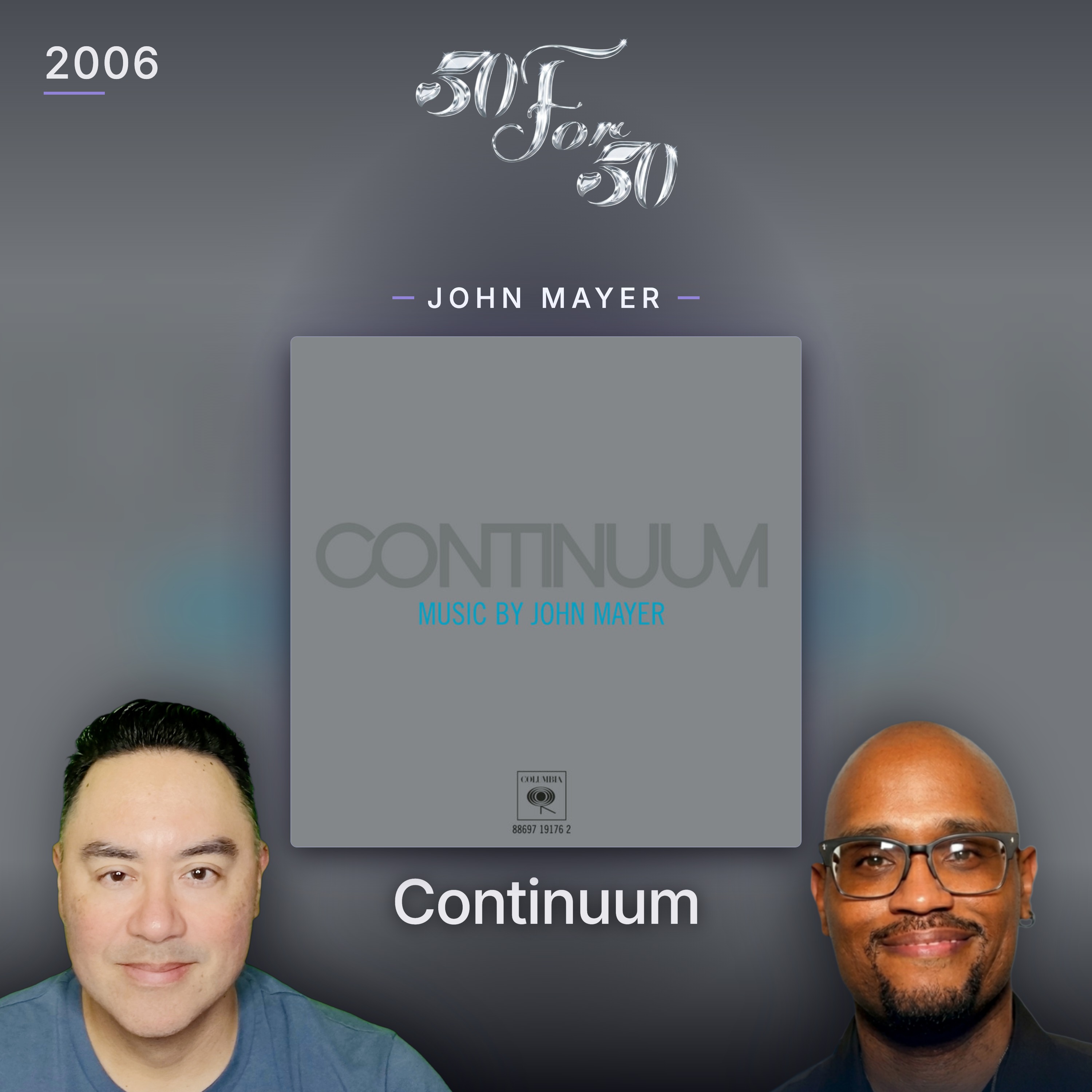


His label told him the album had no hits on it. He cried, almost quit music for design school, and released it anyway — and Continuum went on to sell over 5 million copies and become the record that made John Mayer a serious artist instead of just a hitmaker. Garrett Gonzales and Mike Joseph trace Mayer's path from a Berklee dropout busking in Atlanta to a 7-time Grammy winner, running through his full discography — sales and certifications for every album from Room for Squares through Sob Rock — before getting into the parts of his story that have nothing to do with the music: the Jessica Simpson and Taylor Swift tabloid years, the 2010 Playboy and Rolling Stone interviews that set off a years-long public backlash, and three of his biggest hits that won Grammys and topped charts, only to get torn apart by critics (and by St. Vincent) years later.
From there it's a full Continuum deep dive — how John Mayer Trio bandmates Steve Jordan and Pino Palladino helped build the album after Mayer's label flatly rejected it, studio stories from Memphis's Royal Studios, a track-by-track breakdown, and the three Grammys it won. The episode closes with his touring history, Dead & Company, and the road to his solo Sphere residency in spring 2027 — reuniting the exact trio that made Continuum in the first place — plus Grammy Redux, our Dream Collaborator pick, and Tiers ranking every studio album.
Listen and subscribe:
Website: https://www.50for50.net
Apple Podcasts: https://podcasts.apple.com/us/podcast/50-for-50-life-music-friendship/id1857746432
Spotify: https://open.spotify.com/show/0ADmN7bp4fXQzAZsnSuFQj
YouTube: https://www.youtube.com/@50_For_50
0:10 [SPEAKER_00]: We are back on 50 for 50. [SPEAKER_00]: We took a week off, but we're back and ready to go. [SPEAKER_00]: We're talking about John Mayors 2006 album, continuum, which Mike, at the time, recommended to me. [SPEAKER_00]: Directly, it was like, you just need to listen to this album. [SPEAKER_00]: This is a great album. [SPEAKER_00]: And I appreciated it at the time. [SPEAKER_00]: And I appreciated it today. [SPEAKER_00]: Here we are. [SPEAKER_00]: 20 years later. [SPEAKER_00]: Yeah, craziness. [SPEAKER_02]: It's pretty insane. [SPEAKER_00]: Okay, so I don't remember exactly, but I'm going to guess you were pretty much with Mayor from the first album.
0:53 [SPEAKER_00]: What is your experience with the John, the John mayor, I guess the John mayor experience, what is your experience with John mayor. [SPEAKER_02]: Yeah, I mean, so. [SPEAKER_02]: his first album came out his first real album like his first major label album came out in in 2001. [SPEAKER_02]: And I was working in Iraq. [SPEAKER_02]: I was managing a record store at the time. [SPEAKER_02]: It was [SPEAKER_02]: had to have been maybe a week or two after 9-11 and we were just kind of like cleaning up the store and putting stuff away and I had given myself a project to do and wanted to listen to something while I was doing the project and back in the day and I don't think this was exclusive to my record store, most record stores did this.
1:40 [SPEAKER_02]: like newer artists or developing artists or people who didn't really have like a foothold yet, labels would pay to have them put in listening stations, so people could listen to the records and kind of be like, oh, he was this new thing that I haven't heard before, I'm going to buy the record. [SPEAKER_02]: And John Mayer was one of those listening station records, because, you know, nobody knew who he was yet. [SPEAKER_02]: And for some reason, I was like, let me just play this album. [SPEAKER_02]: I'm going to play it and you know, put my headphones on and listen to it as I was doing my project and fell in love right away. [SPEAKER_02]: So it was maybe a couple of months ahead of the curve there. [SPEAKER_02]: But it did, I think I want to say, Loom for Squares came out on like September 18th, 2001.
2:21 [SPEAKER_02]: Oh wow. [SPEAKER_02]: So it would have been like right around that time. [SPEAKER_00]: Yeah, I mean, I had heard the singles on the radio and he was famous already kind of like for I guess I'm trying to think I'm I'm guessing daughters is maybe where he was like the most famous. [SPEAKER_00]: I don't know if it was necessarily always positive, but [SPEAKER_00]: You know, when this album came out, I was like, okay, I'm listening to this because Mike said it's good. [SPEAKER_00]: But from what I know about this guy, I'm not sure how I feel about him. [SPEAKER_00]: And then listen to this album, pairing it with my own stuff that was that I was going through at the age of 30.
3:05 [SPEAKER_00]: And I was like, hmm, not that we are similar in any way, but some of our experiences might be similar right now. [SPEAKER_00]: And I think that's what resonated with me the most. [SPEAKER_02]: Sure, yeah, actually just looked at my phone. [SPEAKER_02]: So rumors squares did come out on September 18, 2001. [SPEAKER_02]: They don't know how I nail that release date, but I nail that release date. [SPEAKER_02]: And I, you know, I have a memory. [SPEAKER_02]: of us being at karaoke and me singing your body is a wonderland and nobody being down with that at all. [SPEAKER_02]: So you at least had like a passing knowledge of John Mayer prior to this record coming out.
3:48 [SPEAKER_02]: Yes. [SPEAKER_02]: You may not have called yourself a fan. [SPEAKER_00]: No, I like. [SPEAKER_00]: the music that I had heard and I guess the music maybe that became a hit. [SPEAKER_00]: I don't think was an necessarily thing that I liked. [SPEAKER_00]: No, it wasn't until continuum where I really gave it that in depth. [SPEAKER_00]: Listen, and then I would go back because as when we talk about our top five, my number one song is on his second album, not on continued. [SPEAKER_02]: I mean, John Mayer is not somebody who is represented well by the songs that people know the most. [SPEAKER_00]: Yeah, and that we're going to have quite a long rock with its stop with its segment when we get to that top five, too.
4:34 [SPEAKER_00]: Okay. [SPEAKER_00]: Okay. [SPEAKER_00]: So 2006, let's just go through some of the timeline of music in 2006. [SPEAKER_00]: January 14th, M&M, remarries X-Wife Kim after five years of separation. [SPEAKER_00]: And then some less than three weeks later, he files for divorce. [SPEAKER_00]: For a second time. [SPEAKER_00]: Whoa, it's going on there, man. [SPEAKER_00]: He made so many songs about wanting to kill her and stuff and then that Yeah, yeah, if I'm Kim at what point are you like, you know what maybe I shouldn't be messing with this dude anymore I guess you do it for the kid, but, you know, I don't know The 48th annual Grammys on February 8th Madonna opens the show [SPEAKER_00]: Uh, you two is the night's big winner with five awards for how to dismantle an atomic bomb.
5:29 [SPEAKER_00]: They also went to song of the air for sometimes you can't make it on your own and green days. [SPEAKER_00]: Boulevard of Dreams wins a record of the year. [SPEAKER_00]: John Legend, best new artist, Maria 1, 3 of her eight nominations and Kelly Clarkson is the first American [SPEAKER_00]: Mm-hmm. [SPEAKER_00]: February 22nd, the one billion song is downloaded on iTunes. [SPEAKER_02]: Wow, what was that? [SPEAKER_00]: It is a cold place. [SPEAKER_02]: It's a cold place. [SPEAKER_02]: No. [SPEAKER_02]: I'm not very surprising, I guess. [SPEAKER_00]: Speed of sound. [SPEAKER_00]: Okay. [SPEAKER_02]: Mark Billion of Million Billion Billion.
6:09 [SPEAKER_02]: Oh, well. [SPEAKER_02]: Okay. [SPEAKER_00]: Bon Joves second and because of the iTunes structure of how they price their songs, then that means it's a billion dollars that they. [SPEAKER_00]: Yeah. [SPEAKER_02]: Yeah, that would have been before before dollar 29 kicked in. [SPEAKER_00]: How much did the artists get per downloaded song of the 99 cents? [SPEAKER_00]: Yeah. [SPEAKER_02]: I mean, that's a good question. [SPEAKER_00]: I'd probably not much if TLC was alive during the expansion of iTunes. [SPEAKER_00]: How much sense would each member of TLC get per song?
6:51 [SPEAKER_02]: Maybe split in some pennies three ways. [SPEAKER_00]: Yeah. [SPEAKER_00]: Okay. [SPEAKER_00]: March 5th, Bon Jovi second single who says you can't go home from have a nice day goes number one on the country charts for two weeks. [SPEAKER_02]: That's what got about that. [SPEAKER_00]: Three six mafia becomes the first hip hop group African American hip hop group to win in Academy Award for best song. [SPEAKER_00]: And also become the first hip hop artist to ever perform at the Academy Awards. [SPEAKER_02]: That was kind of wild. [SPEAKER_02]: You've never seen hustle and flow.
7:31 [SPEAKER_02]: I've never seen hustle and flow. [SPEAKER_00]: It's really good. [SPEAKER_00]: It's speak well. [SPEAKER_00]: I think [SPEAKER_00]: what what what's what what's the the ladies name Tit Tit Tit Tit is it Taraji Taraji Taraji Taraji Taraji before empire yeah Taraji is really good in this movie and you know Terence is Terence whether you know I think I feel like over the years people have liked Terence less and less but she she's really good in that movie [SPEAKER_00]: All right, April 11th proof is shot and killed by a nightclub balancer at 8 mile road into Troy after allegedly shooting a third man who later dies of injuries.
8:17 [SPEAKER_00]: This is Eminem's homeboy in only six days after Eminem files for divorce from Kim the second time. [SPEAKER_02]: Yeah, Eminem did not have a good week. [SPEAKER_00]: April 15th, Mary J. Blige, be without you and it's 15th week as number one on the U.S. [SPEAKER_00]: Billboard R&B chart making it the most successful R&B song in history. [SPEAKER_00]: Go ahead, Mary J. I was waiting for you to say something. [SPEAKER_02]: I mean, you know, [SPEAKER_02]: I'm sure the song's going to beat it now. [SPEAKER_02]: It's a good song to sound Mary Jay's best song. [SPEAKER_02]: It's perfectly fine. [SPEAKER_02]: I mean, you know, now that it's streaming is so important to the Billboard charts and also R&B is dead, you know, I think there are songs that have longer runs, but they're not as culturally important.
9:07 [SPEAKER_00]: Yeah, I'm not down with the new stats. [SPEAKER_00]: May 24th, Taylor Hicks wins the U.S. television talent contest American Idol. [SPEAKER_00]: Katherine McFee is the runner-up and you watched this season from what I remember. [SPEAKER_02]: This was the first season of American Idol that I watched. [SPEAKER_00]: Did you like Taylor Hicks? [SPEAKER_02]: I like still it, Hicks, I like to Elliot, you know, I thought it was a solid season pretty much all the way through. [SPEAKER_02]: Chris taught you, I think, was number four that season? [SPEAKER_00]: Not the, like, I think it was from a, like, [SPEAKER_00]: from a perspective of all of these folks have different things about them that you like, so it made it kind of interesting.
9:55 [SPEAKER_00]: But there wasn't one artist where I'm sure Simon Cal was like, oh, we're selling a million. [SPEAKER_02]: Like, yeah, that was, I mean, again, I have not a lot of frame of reference for the earlier seasons, but that was kind of the first season. [SPEAKER_02]: Well, dodgerians ended up selling quite a few records. [SPEAKER_02]: I mean, dodgerians are huge for a minute. [SPEAKER_02]: But out of like the top three, there wasn't really anybody that was going to be like a really long-term successful. [SPEAKER_00]: Well, if you watch the first season, you probably figure just off of how popular that show. [SPEAKER_00]: was during that first season that okay killer Clarkson's gonna sell a lot of records like she's just it's just a platform for her she was very nice she's those got that like southern charm she got a powerful voice you're like okay like she'll probably be pretty successful and she has had a fantastic career [SPEAKER_02]: That's exactly Clarkson's still around 25, you know, almost 25 years later.
10:55 [SPEAKER_00]: She gets a bad press recently about yelling at somebody at a clothing store. [SPEAKER_02]: I think it was actually the opposite that happened. [SPEAKER_02]: Like she went to buy something they were like, oh, you can't afford this. [SPEAKER_02]: they didn't know who she was. [SPEAKER_00]: But then I thought the store said that she was lying or something. [SPEAKER_02]: Yeah, I don't think Kelly Clarkson does not strike me as type of person. [SPEAKER_02]: I wouldn't make something like that out. [SPEAKER_00]: She doesn't need the publicity for one. [SPEAKER_02]: Right, she doesn't need the publicity. [SPEAKER_02]: And nobody knows who the hell this store in Brooklyn is. [SPEAKER_02]: So, you know, specifically, the bad press is going to give them more pressed than they've ever had before. [SPEAKER_02]: Sure. [SPEAKER_00]: So in season two, [SPEAKER_00]: You have Rubin vs. Clay, which was kind of a big deal.
11:40 [SPEAKER_00]: It wasn't, I don't think it, I maybe, I don't remember what the ratings would have been, but, and, you know, if you have the, the black guy who sings aren't being music and the white guy who sings pop music and you're like, oh, we can sell this if you're American Idol, but at time you get to season five. [SPEAKER_00]: Taylor Hicks is the most common man out there and he looks like he's 45 and so there's I mean, he wasn't that far off. [SPEAKER_00]: I don't think but I thought they had to be under 30 in order to be on the show. [SPEAKER_02]: Oh, maybe. [SPEAKER_02]: Yeah. [SPEAKER_02]: Okay. [SPEAKER_00]: I think it was like 29. [SPEAKER_00]: And so like from that point of view, like he was different.
12:20 [SPEAKER_00]: And then again, the cat cat McFee who's a little bit more in the like the pop star space and she even did stuff after more in acting and stage play that I think music. [SPEAKER_00]: And then like you said, well, Elliot, you mean, [SPEAKER_00]: He is so yeah, right there 30 he was right around 30 years old so then and then Elliott you mean like he was like [SPEAKER_00]: very likable his the the music that he liked leaned towards what we like so that was cool but yeah dotry had a specific style of music that that sold at that time and he was really good at it but he didn't even really get through the the show as far further than those other people so that was kind of injury but yeah like that like that was like the [SPEAKER_00]: The whole season was like, who's going to win this thing?
13:14 [SPEAKER_00]: Like, that was the whole right to the season. [SPEAKER_00]: Like, there was no front runner. [SPEAKER_02]: And so, kind of interesting. [SPEAKER_00]: And then, you know, you're coming off of Fantasia and season three, Jennifer Hudson, in this actual year, does dream girls. [SPEAKER_00]: So American Idol still out there in 2006. [SPEAKER_00]: Oh, very much so. [SPEAKER_00]: Uh, okay, uh, June 8th, Shakira's hips don't lie, sells 266,000 downloads in his first week of availability. [SPEAKER_00]: Um, it also gains the greatest airplane a single week with 9,657 plays breaking Gwen Stefani's Hollow Back Girl record of 9,582.
13:58 [SPEAKER_00]: Back, the, the, the, the Hollow Back Girl was a moment for Gwen Stefani was in it. [SPEAKER_00]: It really was. [SPEAKER_00]: Taylor Swift releases her first ever single June 19th, Tim McGraw. [SPEAKER_00]: She was 16 years old, the brief moment in time when Taylor Hicks was more popular than Taylor Swift. [SPEAKER_00]: The battle of the day. [SPEAKER_02]: He had like a six month window. [SPEAKER_00]: Justin Timberlake on July 7th released, sexy back to song went to top the Billboard 100 for seven weeks. [SPEAKER_00]: July 30th, the last ever weekly edition of the British television chart showed top of the pops is broadcast after 42 years on the air.
14:48 [SPEAKER_00]: August 15th, Kristinaigular releases back to basics or third album, debut at number one, her first studio album in four years sells 346,000 copies. [SPEAKER_00]: Is that the double album? [SPEAKER_02]: That's the double album. [SPEAKER_02]: Yeah. [SPEAKER_00]: Okay. [SPEAKER_00]: And what was the thing? [SPEAKER_00]: There was a who put, like somebody, a hip-hop producer produced like the South Korean. [SPEAKER_00]: Okay, pre-mode with a bunch of songs on that album. [SPEAKER_00]: Yeah. [SPEAKER_00]: September 3rd, Beyonce releases her second consecutive number one album, B-Day selling 541,000 copies in the first week, B-Day.
15:28 [SPEAKER_00]: I don't remember liking B-Day that much. [SPEAKER_00]: Didn't, was it, no, uh, B-Day, didn't B-Day have single ladies on it? [SPEAKER_02]: I don't know. [SPEAKER_02]: I think it did. [SPEAKER_02]: I think it did, actually. [SPEAKER_02]: No, B-Day had deja vu on it, not at both. [SPEAKER_02]: Now, I think, uh, single ladies was the Sasha Fears album. [SPEAKER_00]: Uh, okay. [SPEAKER_02]: B-Day had deja vu and ring me alarm. [SPEAKER_00]: Yeah. [SPEAKER_02]: And, uh, irreplaceable. [SPEAKER_00]: Right. [SPEAKER_00]: Yeah, yeah, I just remember that album having lots of stuff like more stuff that I didn't like than I liked, um, but that would be the case with I think most be on say I think that's every being on say album.
16:15 [SPEAKER_02]: Yeah, handful of songs I like in a handful of songs that I'm just like this ain't it. [SPEAKER_00]: So the singles deja vu bring the alarm irreplaceable get me bodied wasn't there a jz remix with get me bodied. [SPEAKER_00]: Yeah, and then green light and then beautiful liar was on the deluxe edition. [SPEAKER_02]: Okay. [SPEAKER_02]: I'm not sure. [SPEAKER_02]: I remember beautiful light. [SPEAKER_02]: Oh, wait. [SPEAKER_02]: Beautiful. [SPEAKER_02]: I was just on with Shakira. [SPEAKER_02]: Yes. [SPEAKER_02]: Okay. [SPEAKER_02]: Yeah. [SPEAKER_02]: Yep. [SPEAKER_02]: Yep. [SPEAKER_02]: Yep. [SPEAKER_02]: Yep. [SPEAKER_02]: Yep. [SPEAKER_02]: Yep. [SPEAKER_02]: Yep. [SPEAKER_02]: Yep. [SPEAKER_02]: Yep. [SPEAKER_02]: Yep. [SPEAKER_02]: Yep. [SPEAKER_02]: Yep. [SPEAKER_02]: Yep. [SPEAKER_02]: Yep. [SPEAKER_02]: Yep. [SPEAKER_02]: Yep. [SPEAKER_00]: Yep. [SPEAKER_00]: Yep. [SPEAKER_00]: Yep. [SPEAKER_00]: Yep. [SPEAKER_00]: Yep. [SPEAKER_00]: Yep. [SPEAKER_00]: Yep. [SPEAKER_00]: Yep. [SPEAKER_00]: Yep. [SPEAKER_00]: Yep. [SPEAKER_00]: Yep. [SPEAKER_00]: Yep. [SPEAKER_00]: Yep. [SPEAKER_00]: Yep. [SPEAKER_00]: Yep. [SPEAKER_00]: Yep. [SPEAKER_00]: Yep. [SPEAKER_00]: Yep. [SPEAKER_00]: Yep. [SPEAKER_00]: Yep. [SPEAKER_00]: Yep. [SPEAKER_00]: Yep. [SPEAKER_00]: Yep. [SPEAKER_00]: Yep. [SPEAKER_00]: Yep. [SPEAKER_00]: Yep. [SPEAKER_00]: Yep. [SPEAKER_00]: Yep. [SPEAKER_00]: Yep. [SPEAKER_00]: Yep. [SPEAKER_00]: Yep. [SPEAKER_00]: Yep. [SPEAKER_00]: Yep. [SPEAKER_00]: Yep. [SPEAKER_00]: Yep. [SPEAKER_00]: Yep. [SPEAKER_00]: Yep. [SPEAKER_00]: Yep. [SPEAKER_00]: Yep. [SPEAKER_00]: Yep. [SPEAKER_00]: Yep. [SPEAKER_00]: Yep. [SPEAKER_00]: Yep. [SPEAKER_00]: Yep. [SPEAKER_00]: Yep. [SPEAKER_00]: Yep. [SPEAKER_00]: Yep. [SPEAKER_00]: Yep. [SPEAKER_00]: Yep. [SPEAKER_00]: Yep. [SPEAKER_00]: Yep. [SPEAKER_00]: Yep. [SPEAKER_00]: Yep. [SPEAKER_00]: Yep. [SPEAKER_00]: Yep. [SPEAKER_00]: Yep. [SPEAKER_00]: Yep. [SPEAKER_00]: Yep. [SPEAKER_00]: Yep. [SPEAKER_00]: Yep. [SPEAKER_00]: Yep. [SPEAKER_00]: Yep. [SPEAKER_00]: Yep. [SPEAKER_00]: Yep. [SPEAKER_00]: Yep. [SPEAKER_00]: Yep. [SPEAKER_00]: Yep. [SPEAKER_00]: Yep. [SPEAKER_00]: Yep. [SPEAKER_00]: Yep. [SPEAKER_00]: Um, giving Justin his first number one is a solo selling 648,000 copies in the first week.
17:00 [SPEAKER_00]: Yep. [SPEAKER_00]: October 11th after 25 years as an artist weird al finally gets his first top 10 hit with white and nerdy. [SPEAKER_02]: That's crazy. [SPEAKER_00]: What's your favorite weird al song? [SPEAKER_00]: Oh, God. [SPEAKER_02]: What is my favorite weird al song? [SPEAKER_02]: I don't know. [SPEAKER_02]: I mean, I [SPEAKER_02]: Maybe like Amish Paradise, I don't know. [SPEAKER_02]: It just, you know, he was cool when I was eight, weird hours cool. [SPEAKER_00]: Yeah. [SPEAKER_02]: And then by the time I was a teenager, weird hours not cool. [SPEAKER_02]: And God bless the fact that there are grownups out there who are still down what weird hours, hold on to things that made you special, I guess.
17:43 [SPEAKER_00]: My friend just saw him in a concert recently. [SPEAKER_02]: Yeah, yeah, I have some friends that just saw him recently too. [SPEAKER_00]: My favorite weird-out song. [SPEAKER_00]: I lost on Jeopardy. [SPEAKER_02]: That's a good one. [SPEAKER_00]: But that was also like he said back when we were a little kids when they would run like there was a I think there was an MTV special where they did a whole hour were Owl presented his videos. [SPEAKER_00]: So he presents of course eat it and fat and like surgeon and I lost on jet might have actually been before fat. [SPEAKER_00]: But yeah, I lost on jeopardy was like [SPEAKER_00]: I for whatever reason that hook, I still I can still hear that hook and that's Jeopardy.
18:29 [SPEAKER_02]: And that was before Jeopardy came back with Trebek. [SPEAKER_02]: So, you know, for me, that was the first time I'd ever heard of Jeopardy. [SPEAKER_00]: And then October 24th, Taylor Swift releases her debut self titled album at the age of 16, which sold 39,000 in its first week. [SPEAKER_00]: I think Taylor Hicks, priced more in his first week than that. [SPEAKER_00]: Maybe. [SPEAKER_00]: Yeah, I probably did. [SPEAKER_00]: All right, let's talk about John Mayer. [SPEAKER_00]: I did not know John Mayer's middle name before I started getting into this. [SPEAKER_00]: John's Clayton Mayer. [SPEAKER_00]: He is one year younger than us born October 16th, 1977 in Bridgeport, Connecticut.
19:19 [SPEAKER_00]: is because he watched Michael J. [SPEAKER_00]: Fox play Johnny B. [SPEAKER_00]: Good and back to the future. [SPEAKER_00]: Did you know that? [SPEAKER_02]: That's a good one. [SPEAKER_00]: I did not know that kind of makes sense, right? [SPEAKER_00]: Because white kid playing, you know, R&B style music guitar, music, you know, hip rock music, like that kind of makes sense because, you know, John Mayer saw something in in that where he's like, oh, I kind of want to do this. [SPEAKER_02]: Do that? [SPEAKER_02]: I mean, you know, it fits in with like the age range and everything. [SPEAKER_02]: I mean, I back to the future is still probably my favorite movie of all time, um, and like that scene. [SPEAKER_02]: I remember the first time I saw that and I was like blown away.
20:02 [SPEAKER_00]: I was more blown away when, uh, Huey Lewis was the judge and, and for the, the 30 seconds that he's in the movie, because I was like, wait. [SPEAKER_00]: He sings power of love. [SPEAKER_00]: He sings back in time and he's in the movie. [SPEAKER_00]: Like is this really a huge Lewis project more than a Michael J. [SPEAKER_02]: Fox. [SPEAKER_00]: So he's 13 toxic pops into renting him an instrument. [SPEAKER_00]: Somebody hands him a Stevie Ray Vaughn tape. [SPEAKER_00]: And Meyer, uh, mayor, mayor described what followed as a genealogical hunt backward through the entire lineage of American blues.
20:49 [SPEAKER_00]: So he enrolls at Berkeley College of Music in Boston in 1997, but he did not last very long. [SPEAKER_00]: He and a buddy Clay Cook. [SPEAKER_00]: Clay Cook and John Clayton Mayor and they they relocated to Atlanta informed a short live rock duo called the low five masters. [SPEAKER_00]: uh... they split over musical differences mayor kept pulling toward pophooks while cook wanted to stay rock john goes solo self recording the independent EP inside walks uh... wants out in nineteen ninety nine so his big break comes through uh... an aware records rep heard the EP [SPEAKER_00]: aware put out room for squares in 2001 initially as an internet only release okay can you do it only release in 2001 where people's internet strong enough for that I don't think so I mean we're that that's dial up days then Columbia picked it up gave it a proper commercial rerelease that September like you said and then from there the [SPEAKER_00]: was very fast, your body's a Wonderland becomes a crossover hit, and he suddenly, a Grammy winner.
22:19 [SPEAKER_00]: So we're going to go through a lot of his albums. [SPEAKER_00]: We're here to talk about continuum, but I wanted to kind of just jump through the yearly timeline for John. [SPEAKER_00]: So room for squares, 2001, no such thing in your body as a Wonderland. [SPEAKER_00]: are the hits on that album. [SPEAKER_00]: And then in 2003, he wins for best pay of best male pop vocal performance. [SPEAKER_00]: And then he's also nominated for best artists, but he loses to Nora Jones. [SPEAKER_00]: Right. [SPEAKER_00]: Uh, 2005 daughters wins Song of the Year and best male pop vocal [SPEAKER_00]: and releases the live album try and starts to write, continue them.
23:17 [SPEAKER_02]: And it was second album before that. [SPEAKER_02]: Have you had things came out in O3? [SPEAKER_02]: Right. [SPEAKER_00]: Right. [SPEAKER_00]: Uh, continuing comes out in 2006, sells five million records worldwide. [SPEAKER_00]: and then we get into a little bit of, you know, John, maybe not the best at being a celebrity. [SPEAKER_00]: Not probably needed somebody to help him as far as PR was concerned. [SPEAKER_00]: Just would jump on interviews and answer questions in what he thought was a cheeky way that turned out to be very offensive to some people. [SPEAKER_02]: Right, you know, I mean, look, people picking [SPEAKER_02]: I don't know that anything he said, I found super offensive and here's the dude.
24:05 [SPEAKER_02]: He was, you know, young and famous, you know, swinging his dick around, like, getting laid all the time. [SPEAKER_02]: And he's hanging out with Dave Chappelle, who I assume is not a good influence. [SPEAKER_02]: And, you know, thought he wanted to be a stand-up comedian and it was like doing stand-up [SPEAKER_02]: Rich famous white guy and he said some unaware rich famous white guy stuff and there was a backlash. [SPEAKER_00]: Did he there's a infamous playable interview? [SPEAKER_00]: Did he say the end word in the center view?
24:45 [SPEAKER_02]: He didn't say the end word in the interview. [SPEAKER_02]: He had he was doing stand-up comedy. [SPEAKER_02]: And I think one of his jokes had the end word. [SPEAKER_00]: Okay got it got it. [SPEAKER_00]: Yeah and and he [SPEAKER_00]: was from what I remember, the way that he handled that was just to kind of be a cool funny guy about it. [SPEAKER_00]: And then he realized later that he probably should have to apologize for that stuff. [SPEAKER_00]: And then life turns a little sideways for him because his vocal cords are damaged. [SPEAKER_00]: And I remember there was a point where we were like, [SPEAKER_00]: He's not even going to be able to make music anymore.
25:28 [SPEAKER_00]: We're going to be seeing, you know, yeah, but he makes us come back in 2012 with born and raised, then 2013 is Paradise Valley and since then, he hasn't really been an album making machine, though he's, he does have a couple of albums since then. [SPEAKER_00]: Um, and he is now in 2026. [SPEAKER_00]: He has announced a sphere residency in Vegas for 2027, which is kind of cool. [SPEAKER_00]: Go John. [SPEAKER_00]: How many times have you seen John in, uh, concert? [SPEAKER_00]: Twice.
26:08 [SPEAKER_00]: I think I've seen him twice as well. [SPEAKER_02]: Yeah. [SPEAKER_00]: Yeah. [SPEAKER_00]: So the building in San Francisco where the Warriors and the Valkyries play the Chase Center. [SPEAKER_00]: So it. [SPEAKER_00]: it debuted or it was supposed to debut like right around the time of the pandemic. [SPEAKER_00]: So obviously, you know, it's shut down. [SPEAKER_00]: We can't do stuff. [SPEAKER_00]: And I think the first time I went to the Chase Center post pandemic was a John Mayer concert. [SPEAKER_02]: Oh, well, okay. [SPEAKER_00]: Okay. [SPEAKER_00]: So this dude got pretty [SPEAKER_00]: Famous pretty quickly and very successful very quickly and I think the thing that I like about him the most is he's got a certain I'll say it two ways I feel like there's a moment where he's very much in touch with himself but maybe not in touch with [SPEAKER_00]: the public as much as he is in touch with himself.
27:17 [SPEAKER_00]: And so there is a learning that he's had to go through and let's start with this, waiting for the world to change. [SPEAKER_00]: That song, [SPEAKER_00]: It's not revolutionary in any way, and it is sort of this reactive statement from a successful white dude like who's, you know, who at the time that he made the song was in his late 20s or early 30s. [SPEAKER_00]: did not necessarily like what he saw and was kind of wondering what was going on. [SPEAKER_00]: But he was not at the forefront of like, we need to change, we need to make these changes. [SPEAKER_00]: And we need to do X, Y, and Z. I think he took some flag for it because people like you have this platform, what are you going to do?
28:01 [SPEAKER_00]: And he's like, I'm not doing anything. [SPEAKER_00]: And I don't know that he needed to do anything, but when you put that song out there, [SPEAKER_00]: You're basically trying to say something, but I think when push came to shove, he was like, I'm just making the song. [SPEAKER_00]: Like, I, you know, what do you think about that whole part of him? [SPEAKER_02]: You know, it's funny because this has come up recently. [SPEAKER_02]: I think in reference to Ed Sheeran and not everybody is meant to be a protest singer, right? [SPEAKER_02]: I think you want to be on the right side of [SPEAKER_02]: But you write about what you know and, you know, as a privilege to white guy in 2006, you probably don't know a lot.
28:51 [SPEAKER_02]: So, you know, I mean, you think about songs like waiting for the world to change and it was a very sort of like passive. [SPEAKER_02]: The message of it was passive and you know, you don't want to wait for the world to change. [SPEAKER_02]: You want to change the world right. [SPEAKER_02]: That's, you know, that's the sentiment most people want to hear. [SPEAKER_02]: But when you really look at it, the average person is also waiting for the world to change and isn't being incredibly active in changing the world here. [SPEAKER_02]: It's interesting to think about in retrospect, understand why he caught a lot of crap for it, because people love to, what did Michael call it, throwing stones and throw stones in high jihands?
29:39 [SPEAKER_02]: Like people love to do that. [SPEAKER_02]: And it sort of is what it is. [SPEAKER_02]: I mean, I don't look to John Mayer [SPEAKER_02]: uh, insightful political commentary. [SPEAKER_02]: I looked to John Mayer for making songs that kind of reflect, you know, where I'm at in my staging life in terms of like, you know, living and loving and wanting relationships and that kind of stuff. [SPEAKER_00]: And you know, I think that was part of the flag that would come several years later, because I think people saw him [SPEAKER_00]: as somebody who could have had a voice if he wanted to use it, and everything after that was just so tongue-in-cheek and goofy and playing, you know, just goofing around, that they were like, oh, okay, we get it, and, you know, maybe this other stuff wasn't, you know, that's the real you, not the this other piece.
30:34 [SPEAKER_00]: But I will say, on continuum, there is the political song is on there, [SPEAKER_00]: And it is called belief and like that is the song like if people want to go well waiting for the world to change is so passive that song is not passive that song is that song is out there man like that song makes you think about shit yeah yeah no I agree [SPEAKER_02]: Like, limit or minimize or, you know, what do they call it, single issue voting?
31:17 [SPEAKER_02]: Try to like drill everybody down to like one thing and the reality is that we contain multitudes. [SPEAKER_02]: And, you know, the fact that the same person can write a song like waiting for the world's changing, then write a song called belief, kind of speaks to that. [SPEAKER_00]: Yeah. [SPEAKER_00]: Of course, everyone knows that he also has carried been helping carry the legacy of the grateful dead as a whole member of dead in company. [SPEAKER_00]: And he was also the credited guitarist on Frank Ocean's channel or engine. [SPEAKER_00]: Frank also shows up on was it born and raised or was it paradise [SPEAKER_00]: All right, so you mentioned inside wants out, which is the EP self-released, you know, made it made us a small awareness room for squares, peak that number eight on the Billboard 200, five times platinum by the RIA, heavier things, September 9, 2003, debuted at number [SPEAKER_00]: Certified three x platinum and then continuum and we'll talk about continuum in full Battle studies comes in 2009.
32:38 [SPEAKER_00]: So it is the follow-up to continuum also went platinum He is in his feelings in this ensemble What do you think about battle studies? [SPEAKER_02]: I mean, to me, it's as weak as the album. [SPEAKER_02]: There's a couple of great songs and actually one song from it is in my top five, but I think all in all, it is his, you know, I think by expectations were super high after continuum. [SPEAKER_02]: Yeah. [SPEAKER_02]: And that'll study this is kind of average. [SPEAKER_00]: It's kind of too famous at this point, too, I think. [SPEAKER_00]: And you know, in fame makes you second guess a lot of things.
33:19 [SPEAKER_00]: I'm sure he probably had some other songs that would have fared very well, but he's like, I got, I got to sell this album. [SPEAKER_00]: I got to put this song with Taylor Swift on the album. [SPEAKER_02]: I got to like, I mean, and that's actually a, I like that song, but you know, it's like, continue to me is one of those albums where it's like, top to bottom. [SPEAKER_02]: No skips, right? [SPEAKER_02]: Whereas battle studies, there's like four good songs and everything else is kind of like, eh, I could do it. [SPEAKER_02]: This is gonna go listen and continue them again. [SPEAKER_00]: Born and raised, 2012. [SPEAKER_00]: And it's a little bit of a change for him. [SPEAKER_00]: It's kind of like when we were talking about Justin Timberlick's man of the woods, it's kind of like a similar digression to change, just to change it up.
34:09 [SPEAKER_02]: It's a little roomsy, but I mean, his music was always a little roomsy, so it's not like a huge change. [SPEAKER_00]: And he retreats to Montana. [SPEAKER_00]: not unlike Kanye West, just Kanye West Wyoming. [SPEAKER_00]: Yeah. [SPEAKER_00]: And then Paradise Valley 2013. [SPEAKER_00]: So just over a year later. [SPEAKER_00]: And very similar style to, uh, to Born and Raised. [SPEAKER_00]: Right. [SPEAKER_00]: And then in 2017, he comes out with the search for everything. [SPEAKER_00]: Uh, and though the interesting thing about this album, I mean, I don't I don't think anybody would do this today, but he tried to release them in parts. [SPEAKER_00]: Do you remember this? [SPEAKER_00]: Yeah. [SPEAKER_02]: Yeah, there was like volume 1, volume 2, volume 3.
34:51 [SPEAKER_00]: Yes. [SPEAKER_00]: And so at the end of the four volumes, then you had the full album. [SPEAKER_00]: album. [SPEAKER_00]: Right. [SPEAKER_00]: And then Sobrock in 2021 was kind of his like homage to Yacht Rock, I guess. [SPEAKER_00]: And that was the last album that he's come out with. [SPEAKER_00]: I don't know if he's going to come out with anything new. [SPEAKER_00]: He probably does. [SPEAKER_00]: I have to. [SPEAKER_00]: I don't think he has to. [SPEAKER_02]: Sobrock into his contract. [SPEAKER_02]: Um, so he can, if he wants to put out an album now, he can and he can put it out wherever he wants to put it out, put it out himself, you can do whatever he wants, but I think he's like, I'm a touring musician, I'm not, you know, a 50-year-old guy, I'm out of pop star anymore.
35:32 [SPEAKER_02]: I don't need to be competing with, you know, the adherence of the world or, you know, whoever, know a con or, you know, it's funny because all of these dudes now kind of have a little bit of John Mayeronum. [SPEAKER_02]: You know, it's hard not to hear all these dudes with like acoustic guitars, you know, making a sort of like cookie pop records and not imagine that they were influenced at some point by John there. [SPEAKER_00]: So just a little bit about the celebrity and which is also part of the backlash is um, so he was publicly linked to Jessica Simpson, Jennifer Aniston, [SPEAKER_00]: And Taylor Swift, at a time when she was 19, baby.
36:24 [SPEAKER_02]: And he was going to use early 30s. [SPEAKER_00]: Yeah. [SPEAKER_00]: And so she also shows up on Battle Studies. [SPEAKER_00]: She wrote a song called Dear John that was about him and then he came back with paper doll, which was about her. [SPEAKER_00]: And then from being a celebrity, he made a joke about Jessica Simpson and compared her in the bedroom to sexual napalm. [SPEAKER_00]: Not great for the celebrity appeal in those days to basically talk about how good a woman is in bed, I guess, and to use it in that terminology.
37:15 [SPEAKER_00]: And we mentioned the thing with his stand up in, I think, which hurt [SPEAKER_00]: his relationship with his black fans for a little bit, because they were wondering what's up with this dude. [SPEAKER_02]: You know, I remember talking to my cousin about it and he was, you know, my cousin's like a hip hop dude through and through and he loved John Mayer. [SPEAKER_02]: And I mentioned it to him when he was like, yeah, I don't care. [SPEAKER_02]: I think I think there was a vocal minority of people, particularly black women who were upset. [SPEAKER_02]: with him for saying that, and I don't remember the, I mean, I was upset with them for saying that. [SPEAKER_02]: I like, you know, it's like, come on, dude, you should know better. [SPEAKER_00]: Yeah. [SPEAKER_02]: He's hanging out with Questlove and Dave Chappelle and there's awareness and still he goes and... Well, I mean, again, I don't think Dave Chappelle is like the best influence on anybody, you know, Chappelle is hanging out these days with like Louis C.K.
38:09 [SPEAKER_02]: So, you know, be that as it may, [SPEAKER_02]: cancellable issues, which I think are probably more egregious than John Mayors. [SPEAKER_00]: He loves that Netflix money, man. [SPEAKER_02]: Yeah. [SPEAKER_00]: And Ted Serrand has sure loves him some Dave Chappelle. [SPEAKER_02]: All right, loves making really bad homophobic and anti-trans jokes. [SPEAKER_02]: So, you know, Dave Chappelle isn't like the beacon of shining light of vocalist that he needs to be. [SPEAKER_02]: You know, John should have known better. [SPEAKER_02]: He did apologize for it. [SPEAKER_02]: I think he's sort of gone out of his way to prove that that is not who he is.
38:53 [SPEAKER_02]: And I remember like even back when it happened like India, I reclaimed out in defense of him was like, he's not that dude. [SPEAKER_02]: Like he said something stupid. [SPEAKER_00]: Um, he's trying to be He's trying to be like hip and cool. [SPEAKER_02]: Yeah, whatever. [SPEAKER_02]: Yeah, yeah, and he's yeah, and he just reminds me of like the Dorky white guy who gets to hang with the cool people and thinks he's one of the cool people and doesn't realize that he's still a dork Yeah, he's just like a privileged dork that like has some money and some cashier So the cool people will let him hang out with them [SPEAKER_00]: his quote to Ellen DeGeneres in 2012. [SPEAKER_00]: I lost my head for a little while and did a couple dumb interviews and it kind of woke me up. [SPEAKER_00]: It was a violent crash into being an adult.
39:36 [SPEAKER_00]: My man, you were in your 30s, by the way. [SPEAKER_02]: Some people never learned. [SPEAKER_02]: Some people never learned. [SPEAKER_00]: Okay, just real quick before we get to continue him. [SPEAKER_00]: Some of his songs that made him popular. [SPEAKER_00]: Your bodies in Wonderland. [SPEAKER_00]: It made some worse songs ever lists after the fact, just the idea of, you know, the focus of the song, I guess, where I guess it's John Mayer thinking back to his teenage years in the way that he responded to women back then, who is somebody in this video, somebody famous, isn't it, what's your name from that 70 show?
40:26 [SPEAKER_00]: uh... holly lynch is that i thought it was me laconus uh... yeah i don't know i so i had always thought that the song was written or inspired by jenifer love hewitt [SPEAKER_00]: but mayor said it was about his first high school girlfriend wouldn't be the first song inspired by Jennifer love you and then of course after that one is is daughters which you know people have raked him over the calls for because of the idea that you know every little girl grows up to become a lover than a mother and that's their identity.
41:12 [SPEAKER_02]: it is kind of a silly solve for sure it is a dumb song yeah i mean i think i still think your body is a wonderland is kind of charming like i don't no one's ever going to get me to dislike that song dotters is i you know i didn't really care for it then just because even 20 years ago i was like the song is a little like ikki in a way and then somehow it turned [SPEAKER_00]: uh so what do I know and honestly people probably think of him less do she if he's less famous and if some of those other songs are singles instead of daughters something like daughters yeah there are songs on heavier things that I thought could have been singles [SPEAKER_02]: Yeah, how daughters ended up being a hit I, it goes way over my head because I wouldn't call it.
42:08 [SPEAKER_02]: Um, but you know, you don't know what the public's gonna like. [SPEAKER_00]: Okay. [SPEAKER_00]: So the making of continuum. [SPEAKER_00]: Uh, so we mentioned mayor performing with the John mayor trio. [SPEAKER_00]: And [SPEAKER_00]: It rewired how Mayor wrote, just like that group, that album that they put out. [SPEAKER_00]: He wrote, or he said, if you have a different orchestra, a different band, you can compose differently, that literally changed the way I compose songs. [SPEAKER_00]: So from 2005, January 2005, to July 2006, across four studios, LA, New York, Memphis, [SPEAKER_00]: Steve Jordan co-produced and mayor said that Steve Jordan is the sound of me, but better.
43:06 [SPEAKER_00]: And that's how appreciative he was of their creative relationship. [SPEAKER_00]: The album was a pivot from the previous and he wanted to make a record that was going to last [SPEAKER_00]: what your best record is and give it that title like the title really works on this album. [SPEAKER_02]: Yeah, for sure. [SPEAKER_00]: Uh, so when he turned the album in, the label told him that it had no hits. [SPEAKER_00]: And he was really devastated. [SPEAKER_00]: I mean, I guess this is how you get daughters, right?
43:47 [SPEAKER_00]: It's like when you have to like find something that the label, you know, wants here. [SPEAKER_00]: I've been reading through Clive Devices biography from gosh, it's been over 10 years. [SPEAKER_00]: It is really dry and really boring and it's taking me forever to get through [SPEAKER_00]: But, you know, he's got these experiences with certain artists that, you know, our kind of legendary artist, but he's like, you know, I'm not sure if there's an actual hit on this album, you know, and so having to go through that. [SPEAKER_00]: But, Clive, of course, paints himself as someone who's willing to work with folks over that and not turn them away.
44:30 [SPEAKER_00]: So he said, [SPEAKER_00]: One time, I handed it an album and I was told it had no hits on it. [SPEAKER_00]: I cried. [SPEAKER_00]: I told myself I was going to quit and go to design school. [SPEAKER_00]: So that's his story for a continuum. [SPEAKER_00]: He didn't go back and chase a single. [SPEAKER_00]: He released the record as it was conceived. [SPEAKER_00]: So good on him for a holding on that. [SPEAKER_00]: Yeah. [SPEAKER_00]: Stop this train was written during what mayor called a period of solitary refinement. [SPEAKER_00]: He was dealing with double-kiddy stones and living out of a hotel. [SPEAKER_00]: Oh my God, I'm searching for a new place to live. [SPEAKER_00]: Not not quite stranger in Moscow, I don't think.
45:10 [SPEAKER_02]: No. [SPEAKER_02]: No, no, no, no, no. [SPEAKER_00]: But anytime someone talks about, like, just feeling completely alone, I just think of Stranger in Moscow. [SPEAKER_02]: We've been Moscow, different circumstances. [SPEAKER_00]: Which we'll talk about on our next Michael Jackson episode. [SPEAKER_02]: Yes. [SPEAKER_00]: So, [SPEAKER_00]: There was a tsunami benefit concert and then the first official recording session happened after that in Times Square. [SPEAKER_00]: Steve Jordan said the room had a necessary vibe and they tracked live with basis Willie Weeks rather than piecing parts together separately.
45:53 [SPEAKER_00]: And so there was [SPEAKER_00]: Mayer tracked vocals on one song using Al Green's actual vintage RCA 77 ribbon microphone. [SPEAKER_00]: Nice. [SPEAKER_00]: Interesting. [SPEAKER_00]: Boldest love mayors cover of Jimmy Hendrix's song marks the first ever studio Hendrix cover. [SPEAKER_00]: a significant marker given how central Hendrix is to his own guitar lineage. [SPEAKER_00]: And that comes from the Wikipedia version of the continual malbum history. [SPEAKER_02]: Okay. [SPEAKER_02]: Well, John Mayer's first Hendrix cover.
46:34 [SPEAKER_02]: It's not B first. [SPEAKER_02]: It's like there were definitely lots of Hendrix covers before. [SPEAKER_00]: Yeah. [SPEAKER_00]: Yeah. [SPEAKER_00]: Mayer's first Hendrix. [SPEAKER_02]: Yes. [SPEAKER_00]: Cover. [SPEAKER_00]: Okay, so going track by track waiting for the world, wait, wait, not on the world to change. [SPEAKER_00]: The lead single ended up as the kind of the identity for the album because the single was was popular, very popular and it won him the best male pop vocal performance at the Grammys song number two. [SPEAKER_00]: I don't trust myself with loving you bluesy relationship type song. [SPEAKER_00]: Um, and it shows a change in his music on this album right right from the get go from song.
47:17 [SPEAKER_00]: Okay. [SPEAKER_00]: Believe, which we already talked about and we'll talk about it more in the top five, because it is in my top five hint hint. [SPEAKER_00]: And gravity, which is the song that he likes to talk about a lot. [SPEAKER_00]: Um, it grew out of the trio's, the John Mayer trio's life sets and later became a Grammy winner in its live incarnation and has rocked, racked up, 530 million Spotify streams. [SPEAKER_00]: Why is it? [SPEAKER_02]: Well, gravity been so successful after the fact, I mean, next day did I, it was one of his more popular songs. [SPEAKER_02]: Um, I mean, certainly not my favorite, but I, you know, he's so he plays it a lot.
48:03 [SPEAKER_02]: Um, and actually, I think the first, no, it was the second time I saw him, he actually brought Alicia Keys out to sing it with them, um, because she's on the record. [SPEAKER_00]: Mm-hmm. [SPEAKER_00]: Heart of life, um, then volatures. [SPEAKER_00]: uh... written by i think one of the guys who's in the john mayor trio uh... maybe both of them actually and then then stop this train which we mentioned uh... well he's had my man's dinner with kidney stones and there's a feet fear of of growing older and he he watches his parents age and you know i've definitely had that thought process uh... in my life and and i understand that song a lot [SPEAKER_00]: slow dancing in a burning room.
48:50 [SPEAKER_02]: Man, I keep adjusting my list. [SPEAKER_00]: He likes to play this song live as well. [SPEAKER_00]: And then we talked about Boulders Love. [SPEAKER_00]: Dreaming with a broken heart. [SPEAKER_00]: Now this one is pretty interesting song. [SPEAKER_00]: He's like super vulnerable in this song. [SPEAKER_00]: And I wondered, like, who this song is about? [SPEAKER_00]: I've been wondering that for a long time. [SPEAKER_00]: OK, I even reached out to him on Twitter in the very early days of Twitter when he was like all over Twitter, but he never, he never answered me. [SPEAKER_00]: So I never, I never got an answer to the song. [SPEAKER_00]: Keep in the mystery. [SPEAKER_00]: Yeah. [SPEAKER_00]: In repair, I'm going to find another U, which is very sort of like, [SPEAKER_00]: it's like a it's a breakup song but it's like you're still mad at the breakup like you're you know you're like trying to one up the other person and maybe maybe you're even on [SPEAKER_00]: the worst side of the breakup, and then it's a breaking up song and it's an F. You song.
50:00 [SPEAKER_00]: Yeah. [SPEAKER_00]: And then say, which was not on the original version of the album for what I remember. [SPEAKER_02]: No, it was not. [SPEAKER_02]: It was in the movie, the bucket list, if I remember correctly. [SPEAKER_02]: and then they stripped it onto the album after the bucket list became a hit. [SPEAKER_00]: So, clearly, his best album, like I don't think anybody would argue this. [SPEAKER_02]: I mean, I, you know, I'm sure there are people who would argue it. [SPEAKER_02]: It is my favorite album of his, for sure. [SPEAKER_02]: And, you know, there's only, of his entire catalog, there's really only one album that I think is average. [SPEAKER_02]: You know, and everything else is sort of better than average, but continuum.
50:41 [SPEAKER_02]: I like, you know, [SPEAKER_02]: continue on and future sex love sounds came out on the same day. [SPEAKER_02]: And I remember I came home with both of them and I think I had gotten a promo of one and I bought the other one I can't remember which was which was which. [SPEAKER_02]: I think I got the promo of John Mayer because I had to review that for pot matters. [SPEAKER_02]: And I remember listening to them both and being like this John Mayer album is like 50 times better than this Justin Timberlake record. [SPEAKER_02]: Yeah. [SPEAKER_02]: And being really surprised at that. [SPEAKER_02]: So, you know, it's one of those albums that for me, excuse me, like an all-timeer, like I'll never get tired of that record.
51:26 [SPEAKER_00]: Yeah. [SPEAKER_00]: No, me too. [SPEAKER_00]: It was one in which I connected with immediately after you told me to get it. [SPEAKER_00]: I actually, here's the story. [SPEAKER_00]: So you and I were talking about it. [SPEAKER_00]: I think I went to Rasputin records in San Jose and immediately went to buy it. [SPEAKER_00]: So at that point, like there was already iTunes as we know, but I don't think it was easy for me to download an album and then rip it so that I could put it on CD and you know, we had iPods back then I think.
52:07 [SPEAKER_00]: But I was like, yes, I want the physical product of this. [SPEAKER_00]: And so I just immediately went on my way home, bought the album and then just threw it in my car because that's how it listened to most music back then because that's such a long commute. [SPEAKER_00]: And so I was like, I need this in my car. [SPEAKER_00]: I'm not sure if I had the iPod gimmick working with the car stereo at that point yet, but so that was it. [SPEAKER_00]: I just went immediately got it and then listened to it on the way home. [SPEAKER_00]: Okay, so let's tear these albums. [SPEAKER_00]: So continuum is obviously in your muscle listen tier. [SPEAKER_00]: What else is in your muscle listen tier? [SPEAKER_02]: And I would probably put that in heavier things in my muscle listen tier.
52:50 [SPEAKER_02]: I think those are as two, two best albums and everything's just so concise. [SPEAKER_02]: It's only like nine songs or 10 songs. [SPEAKER_02]: So, you know, pull daughters out of that mix and it's a really, really good record. [SPEAKER_00]: And then in your mid tier. [SPEAKER_02]: I'm on my mid tier is going to be everything except battle studies. [SPEAKER_00]: Oh, wow. [SPEAKER_00]: So even the search for everything, even saw Brock, even. [SPEAKER_02]: I mean, those are, I think search everything in subrock or great records in Paradise Ali and that's Valley. [SPEAKER_00]: I keep saying Paradise Ali because Paradise Ali is a Sylvester Stallone movie from like the early 80s or the late 70s. [SPEAKER_00]: And then born and raised. [SPEAKER_00]: Yeah, paradise Paradise Ali.
53:33 [SPEAKER_00]: look at it. [SPEAKER_02]: It's it's it's actually ever heard of it in my life. [SPEAKER_00]: It's actually about professional wrestling from like the 1970s Really That is brand new to me [SPEAKER_00]: So I can't, I don't have a four stands only John Mayer album, even battle studies. [SPEAKER_00]: It's very listenable to me. [SPEAKER_00]: It's kind of like, listenable like in a movie that is not great, but it's like a good popcorn flick. [SPEAKER_00]: Like that's kind of what battle studies is to me. [SPEAKER_02]: Okay. [SPEAKER_02]: Yeah, I just, yeah, I think you like it a little bit more than I do.
54:17 [SPEAKER_00]: that when I was doing a lot more writing, you know, we're going back 10, probably more than 10 years go probably like 10 to 15 years ago. [SPEAKER_00]: I was doing way more writing than I am now. [SPEAKER_00]: I would basically take mayors. [SPEAKER_00]: Discography and just play all of the albums in order. [SPEAKER_00]: Well, it was like fantastic writing music for me. [SPEAKER_00]: It was just to listen to John Mayer's Discography. [SPEAKER_00]: And like there's some, like I can do, I can kind of do it with Stevie as well, but sometimes Stevie's music is just a little bit too jamming and then I get kind of, you know, I guess I can have a game a little bit. [SPEAKER_00]: Yeah, but Mayor stuff is like right in the pocket of like perfect mood music for me to write in.
55:06 [SPEAKER_00]: Yeah, man. [SPEAKER_00]: Okay. [SPEAKER_00]: No skip trading. [SPEAKER_00]: For me, continuum is like a 10, 9.5, 10. [SPEAKER_02]: Yeah, it's like a 9.5. [SPEAKER_00]: All right. [SPEAKER_00]: So we're going to focus. [SPEAKER_00]: And we've already talked about this one, I think. [SPEAKER_00]: We're going to focus on the 2007. [SPEAKER_00]: Grammys for album of the year in our in our section of Grammy Redux. [SPEAKER_02]: So yeah, we might have talked about that when we talked about Justin. [SPEAKER_00]: Yeah, we did, but we'll just we'll just go over it again. [SPEAKER_00]: Alm of the year. [SPEAKER_00]: The nominees feature sex love sounds. [SPEAKER_00]: Justin Timberlake and like you said, they came out on the same day.
55:48 [SPEAKER_00]: Continuum John Mayer Stadium Arcadeum. [SPEAKER_00]: uh, retouch chili peppers produced by Rick Ruben, uh, Saint elsewhere, Norles Barkley, produced by Danger Mouse, and then the one that wins taking the long way to Dixie Chicks. [SPEAKER_00]: Also, Rick Ruben, a producer on that album. [SPEAKER_00]: Yep. [SPEAKER_02]: Yep. [SPEAKER_00]: Um, rank those. [SPEAKER_02]: Uh, chilly peppers is number five because that's a double album and two albums is way too much read how chilly peppers. [SPEAKER_02]: Um, I'd probably put the Dixie chicks number four. [SPEAKER_02]: Um, that is a good album.
56:28 [SPEAKER_02]: Um, Timberlake three knows Barclay two, John Mayer one. [SPEAKER_00]: There you go. [SPEAKER_00]: Yeah. [SPEAKER_00]: Um, all right. [SPEAKER_00]: So. [SPEAKER_00]: Uh, we are done outside of two things. [SPEAKER_00]: And I had a thought on hot take, though this one is tough because I don't want to change anything about John Mayer's process because we get really good music, but I feel like [SPEAKER_00]: And this is not a good thing for him, by the way. [SPEAKER_00]: But I feel like he could have achieved a level of super start-up that very few get to if he just had someone to tell him when to shut the fuck up.
57:21 [SPEAKER_02]: I think, you know what? [SPEAKER_02]: It's weird, I'm thinking of him and I'm thinking of Janet and [SPEAKER_02]: Like, a lot of people are like, well, Janet's career fell off because of the superbowl thing. [SPEAKER_02]: I'm like, but in addition to the superbowl thing, she made a very mid record. [SPEAKER_02]: Like, John Mayer obviously didn't what he did wasn't viewed on the same level as what Janet had did at the superbowl. [SPEAKER_02]: You know, he said some some outlandish stuff, you got him in trouble, but the album that he was promoting when he did all that stuff was not a great record. [SPEAKER_02]: So it's not just the one thing, like it's a combination of making a record that wasn't necessarily the best record and then getting all this like backlash in the press.
58:13 [SPEAKER_02]: So I think it was, it was not one of the other but it was both. [SPEAKER_00]: But it was also, [SPEAKER_00]: the being a young, attractive dude, hooking up with very visible celebrity women, and then getting bad feedback spilled about you constantly. [SPEAKER_00]: Like there's another piece of that where it's like, maybe if you did this a little bit more carefully, you would have gotten this bad feedback too. [SPEAKER_02]: I'm not going to say dudes are going to be dudes because that's wrong.
58:54 [SPEAKER_02]: Do you just shouldn't be dudes? [SPEAKER_02]: Yeah. [SPEAKER_02]: Um, I do think that when you are young and you are famous and people are throwing themselves at you, self-awareness is not, you have to have a really, really high level of self-awareness to not like. [SPEAKER_02]: fall all the way into the morass of, you know, all the other stuff that kind of comes with being famous. [SPEAKER_02]: And, you know, I think he was suffering enough to know that he had gone too far and then got out of it, but he wasn't suffering enough to not fall into it in the first place. [SPEAKER_00]: Yeah, I always go back to that Martin standup when he was like, when I first started doing jokes, I was funny, Martin.
59:39 [SPEAKER_00]: And then when I started to become a little bit more famous, I was cute Martin, and then I got my own TV show, I was fine. [SPEAKER_02]: Yep, yeah. [SPEAKER_02]: I mean, and that's kind of the way that that works. [SPEAKER_02]: It's like you could be the ugliest, most uncharming person, but your sexiness factor goes up significantly if you got some money in your pocket. [SPEAKER_00]: President of the United States when he was younger, man, yeah, yeah. [SPEAKER_02]: I mean, you know, so it's like, you got to in order to be able to resist that, you got to be have a particular least wrong backbone.
1:00:26 [SPEAKER_02]: And I just don't know that most 25 or 28 or 29 year old people have that backbone. [SPEAKER_00]: Yeah, I mean, he's like, [SPEAKER_00]: I was at Berkeley music for two semesters. [SPEAKER_00]: And now I'm out here and Jessica Simpson wants to date me. [SPEAKER_02]: Right, so what's going on? [SPEAKER_02]: Right, right, exactly. [SPEAKER_02]: Yeah, it's like, what do you do, like, you know? [SPEAKER_02]: If I had been putting that situation when I was 20, 28 or 29 years old, certainly when I was younger than that, if I was a straight dude with money, 28, 29, I would have been banging every body.
1:01:09 [SPEAKER_02]: As it was, I was broke as a joke, and I was still, but out there. [SPEAKER_02]: You know, I was just gonna be in a hole. [SPEAKER_02]: Like, so it, you know, [SPEAKER_02]: I can only imagine what like status like I would have lost my mind, yeah, and you know me now with 50 year old brain, if, you know, not that this is ever going to, if I was to one day like strike it rich or become famous or even in like my little pocket of like detoxicity like I've been recognized before sure like, you know, [SPEAKER_02]: And even that can be like a little intoxicating. [SPEAKER_02]: So I can only imagine what like at a younger age that full on like, oh shit, you're Mike Joseph, blah, blah, blah, blah, blah, what that would have been like.
1:01:58 [SPEAKER_02]: I wouldn't have been able to withstand, you know, like your young and stupid, like you just don't know. [SPEAKER_00]: Yeah, for sure. [SPEAKER_00]: I mean, I think that just also messes with your brain chemistry, right? [SPEAKER_00]: You go from not having a ton of attention or having normal attention to having like everybody wants to know who you are and what you're doing and and it probably just messes with you. [SPEAKER_02]: It does. [SPEAKER_02]: I mean, this is why people, you know, I just finished reading this book about Whitney and, you know, this is why people like fall off the deep end because it's like you go from nothing or something and all of a sudden everybody wants to PC you and you could, you know, you could play it a bunch of different ways, but none of the ways that you can play it are good.
1:02:40 [SPEAKER_00]: Yeah. [SPEAKER_00]: Yeah. [SPEAKER_00]: You know, you're always going to disappoint somebody. [SPEAKER_02]: Yeah. [SPEAKER_02]: Yeah. [SPEAKER_02]: And, you know, kudos to him for being able to snatch it back. [SPEAKER_00]: All right, we're going to actually know what dream collaborator and like the he's worked with some that I was he's worked with awesome [SPEAKER_00]: Yeah. [SPEAKER_00]: You know, you're so frank ocean, you got Alisha, there are others that would be kind of interesting. [SPEAKER_00]: I mean, he's done stuff with the roots before. [SPEAKER_02]: So he did a record work, Kanye that never came out, he's on commons record, like he's done some interesting stuff.
1:03:24 [SPEAKER_02]: So. [SPEAKER_02]: The last, actually, I take that back. [SPEAKER_02]: I haven't seen him twice, I've seen him three times. [SPEAKER_02]: And the third time I saw him was with DeAngelo. [SPEAKER_02]: Oh, wow. [SPEAKER_02]: And I am 100% certain that there is studio stuff of John Mayer and DeAngelo. [SPEAKER_02]: And I would love for that stuff to come to light at some point. [SPEAKER_02]: But yeah, the last time I saw him live was root spiknik, 2016, 2017. [SPEAKER_02]: Oh, wow. [SPEAKER_02]: That's incredible. [SPEAKER_02]: Yeah. [SPEAKER_00]: Yeah. [SPEAKER_00]: I was trying to think of somebody who kind of fits a similar space as like a Frank ocean.
1:04:05 [SPEAKER_00]: Some of the ones that I kind of looked up and and people thought have thought about in the past were like Rafael sedique. [SPEAKER_00]: Somebody like that. [SPEAKER_00]: Yeah, that would be really interesting. [SPEAKER_00]: I think not too late. [SPEAKER_00]: I know. [SPEAKER_00]: We're we're still going to do an episode on Sadik at some point. [SPEAKER_00]: Yeah. [SPEAKER_00]: Um, so we're going to do our top five, which is going to be next. [SPEAKER_00]: But the next full 50 for 50. [SPEAKER_00]: I think it's time for purple rain, man. [SPEAKER_02]: I mean, if, if you're going to listen to Prince's catalog. [SPEAKER_00]: Okay. [SPEAKER_00]: So this is my suggestion. [SPEAKER_00]: What? [SPEAKER_00]: So post purple rain.
1:04:49 [SPEAKER_00]: I'm trying to think of like where a good stopping point is so that we could kind of split it in half kind of like what we're doing with mj and what we what we can do is we could do the second half of prints after we're done with the first 50 and it'll be like album 51 or something that whatever whatever that album is. [SPEAKER_02]: If you want to split prints in half you do everything up to where he changes name. [SPEAKER_02]: And then, you know, so what happens with that way? [SPEAKER_02]: That would be the love symbol album. [SPEAKER_00]: Okay. [SPEAKER_02]: Like the album is literally the title of the, the title of the album is literally like the symbol. [SPEAKER_02]: And then you would stop there.
1:05:30 [SPEAKER_02]: And then like, then listen everything after for another, another time. [SPEAKER_00]: Because my man has all kinds of different albums that I've never heard of. [SPEAKER_02]: Heard of, yeah. [SPEAKER_00]: So, we do purple rain. [SPEAKER_00]: And then 85 is around the world in a day. [SPEAKER_00]: 86 is under the cherry moon. [SPEAKER_00]: 87, sign of the times. [SPEAKER_00]: 88, love sexy, 89. [SPEAKER_00]: Batman, 90 graffiti bridge, 91 Diamond Pearls. [SPEAKER_02]: And then the symbol album is 92. [SPEAKER_02]: And then he changes his name in 93. [SPEAKER_00]: Okay, what is this?
1:06:10 [SPEAKER_02]: I don't have the Apple Apple music is not showing me the 92 album unless it's like it's it's on there it's been redistributed and they put like a date on like a reissue Nader something like it's hard because it's like it doesn't have like a title title What is it show as on Apple music Hold on I'll link you [SPEAKER_02]: aaaaaaaaaaaaaaaaaaaaaaaaaaaaaaaaaaaaaaaaaaaaaaaaaaaaaaaaaaaaaaaaaaaaaaaaaaaaaaaaaaaaaaaaaaaaaaaaaaaaaaaaaaaaaaaaaaaaaaaaaaaaaaaaaaaaaaaaaaaaaaaaaaaaaaaaaaaaaaaaaaaaaaaaaaaaaaaaaaaaaaaaaaaaaaaaaaaaaaaaaaaaaaaaaaaaaaaaaaaaaaaaaaaaaaaaaaaaaaaaaaaaaaaaaaaaaaaaaaaaaaaaaaaaaaaaaaaaaaaaaaaaaaaaaaaaaaaaaaaaaaaaaaaaaaaaaaaaaaaaaaaaaaaaaaaaaaaaaaaaaaaaaaaaaaaaaaaaaaaaaaaaaaaaaaaaaaaaaaaaaaaaaaaaaaaaaaaaaaaaaaaaaaaaaaaaaaaaaaaaaaaaaaaaaaaaaaaaaaaaaaaaaaaaaaaaaaaaaaaaaaaaaaaaaaaaaaaaaaaaaaaaaaaaaaaaaaaaaaaaaaaaaaaaaaaaaaaaaaaaaaaaaaaaaaaaaaaaaaaaaaaaaaaaaaaaaaaaaaaaaaaaaaaaaaaaaaaaaaaaaaaaaaaaaaaaaaaaaaaaaaaaaaaaaaaaaaaaaaaaaaaaaaaaaaaaaaaaaaaaaaaaaaaaaaaaaaaaaaaaaaaaaaaaaaaaaaaaaaaaaaaaaaaaaaaaaaaaaaaaaaaaaaaaaaaaaaaaaaaaaaaaaaaaaaaaaaaaaaaaaaaaaaaaaaaaaaaaaaaaaaaaaaaaaaaaaaaaaaaaaaaaaaaaaaaaaaaaaaaaaaaaaaaaaaaaaaaaaaaaaaaaaaaaaaaaaaaaaaaaaaaaaaaaaaaaaaaaaaaaaaaaaaaaaaaaaaaaaaaaaaaaaaaaa [SPEAKER_02]: I don't know why it would be out of order, but it's definitely, it's definitely on Apple Music.
1:07:15 [SPEAKER_00]: Well, um... [SPEAKER_00]: So if we do purplerane next, I was thinking maybe we get through 1990, I don't know if I'll be able to, because I am listening to purplerane right now. [SPEAKER_00]: So I've gotten through the early albums until then. [SPEAKER_00]: So I would still have one, two, three, four, five, six. [SPEAKER_00]: I would still have seven albums to get through diamonds and pearls. [SPEAKER_00]: Why don't we stop at graffiti bridge. [SPEAKER_00]: So 90's a nice cutoff spot.
1:07:58 [SPEAKER_00]: And then we'll pick it back up in, you know, like I said, after we get through our last 50 for 50 album. [SPEAKER_00]: There's, and there's so much. [SPEAKER_00]: Okay, so I think I can get through those albums and be good and I also want to watch purple rain and talk about I was going to suggest that yeah so that's something we should also do for the the next the next one so okay like yeah I I got through a good amount of it and I'm listening to purple rain and it's been quite the experience and I'm like [SPEAKER_00]: I just remember, and this is a John Mayer episode, but I just remember my uncle, like being into Prince and my dad, like not being into Prince at all, and I was like, okay, I get it, like there's the way he looks or whatever, like he's like very suggestive in his movements and stuff.
1:08:51 [SPEAKER_00]: If you're trying to raise young children, maybe why you want to avoid Prince, and then my uncle would always tell me how cool Prince was. [SPEAKER_00]: But then I heard some of some of these songs where he's talking about incest and stuff and I go, okay, I understand why pops didn't help. [SPEAKER_02]: I mean, I printed shit, you know, was very racing, very racing. [SPEAKER_00]: But, you know, I mean, I commend him for being so out there at the same time. [SPEAKER_02]: So, I mean, he was trying to get a rise out of people. [SPEAKER_02]: Yeah. [SPEAKER_00]: totally. [SPEAKER_00]: Okay. [SPEAKER_00]: Yeah. [SPEAKER_00]: So the love symbol. [SPEAKER_00]: Oh, I wonder if it's, I wonder if does Apple music like separate prints in the new power generation stuff like what's possible?
1:09:33 [SPEAKER_00]: I hate it when they can't figure out all all that stuff. [SPEAKER_00]: Okay. [SPEAKER_00]: We'll be back with the top five in the next week or I don't know if it'll be next week, but it'll be the next official episode. [SPEAKER_00]: Uh, what we will do, uh, the purple rain album and also talk a little bit about that movie. [SPEAKER_00]: And [SPEAKER_02]: All right. [SPEAKER_02]: He's only got three movies. [SPEAKER_00]: Okay, so that is it from here for Mike. [SPEAKER_00]: I'm WC when we see you piece out